

What U.S. companies actually pay in nearshore salary
What U.S. companies actually pay in nearshore salary
When US companies start exploring nearshore talent in Latin America, the first question is almost always the same: how much does it cost?
The range varies by role, seniority, and country, but as a general benchmark, nearshore salaries in LatAm run between $2,000 and $8,000 per month, compared to $5,400 to $16,000 for equivalent roles in the US.
That gap translates into budget flexibility.
Depending on the role and where you hire, companies typically save between 20% and 70% on monthly labor costs, without compromising on quality, timezone alignment, or communication.
What does "nearshore salary" mean?
Nearshore salary refers to the compensation paid to professionals hired in geographically close countries, typically in Latin America, for US-based companies.
Unlike offshore talent in Asia or Eastern Europe, nearshore talent works in similar or overlapping time zones, making real-time collaboration straightforward.
The salary structure itself is usually straightforward: a monthly rate paid in USD to the professional, either through a local employer of record, a staffing partner, or directly as a contractor.
There are no standard employer taxes, benefits, or office costs layered on top of the way they are with US-based hires.
What are the typical nearshore salary ranges by role?
The table below reflects current market rates based on GoFasti's active placements across Latin America, compared to average US salaries for the same roles.
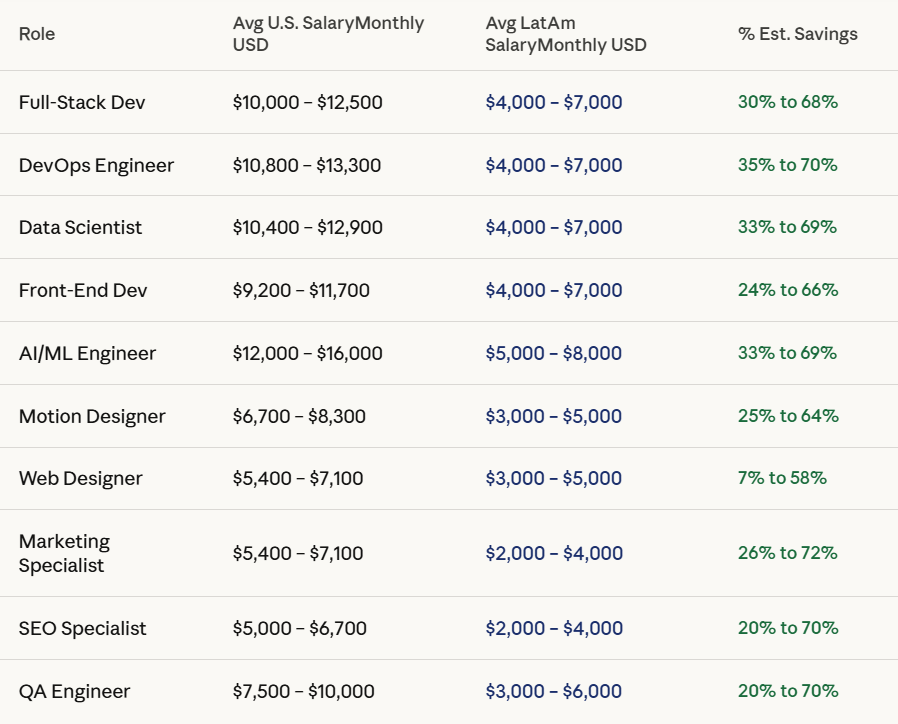
A few things worth noting here. The savings range is wide because it depends on where in the salary band you hire. Senior talent costs more in both markets.
A senior DevOps Engineer in LatAm might earn $7,000/month, while a mid-level one might come in at $4,500.
Both represent meaningful savings over US rates, but the absolute number matters for budgeting.
What drives salary differences within LatAm?
Not all Latin American countries have the same salary expectations.
Within the region, compensation levels vary based on the local cost of living, the maturity of the local tech ecosystem, and the volume of US companies already hiring there.
As a general pattern, countries with stronger US market exposure and higher local demand, like Colombia, Mexico, and Brazil, tend to have higher average salaries than emerging markets.
That said, talent quality across the region has risen consistently, and the correlation between cost and competency is not linear.
How does a nearshore salary compare to the full cost of a US hire?
The monthly salary gap is one part of the picture.
When you factor in total employment costs for a US-based hire (payroll taxes, health benefits, 401k contributions, recruiting fees, and office overhead), the actual cost of a $120,000/year US employee is often closer to $160,000–$180,000 annually.
For a nearshore hire in LatAm, the total cost is typically closer to the salary itself.
Most companies work with a staffing or employer-of-record partner who handles local compliance, which adds a service fee, but the combined cost remains well below the fully-loaded US equivalent.
For a single senior Full-Stack Developer, for example:
- US-based fully-loaded cost: ~$10,000–$17,000/month
- LatAm nearshore (senior): $5,000–$7,500/month, all-included
For a team of five engineers, that difference compounds quickly.
What about quality? Does lower salary mean lower output?
This is the right question to ask, and the honest answer is: it depends on how you hire, not where you hire.
Latin America has a large and growing pool of professionals with strong technical foundations, international work experience, and fluency in English.
Many LatAm developers have contributed to US product teams for years, and the region has produced consistent talent across web development, data engineering, AI/ML, and creative roles.

The risk is not geography; it's hiring without proper vetting.
A nearshore developer hired through a well-structured process (technical assessments, behavioral interviews, reference checks, and trial periods) will perform comparably to any equivalent US hire.
The failure cases in nearshore talent acquisition are almost always the result of cutting corners in the hiring process, not a reflection of the talent pool itself.
How long does it take to hire nearshore talent?
The timeline depends on the complexity of the role and the hiring process used. For most roles:
- Standard technical roles (Front-End, QA, Marketing): 2–4 weeks from kickoff to offer accepted
- Senior or specialized roles (AI/ML, DevOps, Data Science): 3–6 weeks
- Niche profiles or leadership roles: 6–10 weeks
These timelines assume a clear job brief, responsive feedback from the hiring team, and a structured interview process.
Delays almost always trace back to unclear requirements or slow decision-making on the client side, not to candidate availability.
Companies like GoFasti maintain active pipelines of pre-vetted talent in Latin America, which can reduce time-to-hire significantly.
On average, our clients typically hire their ideal candidates within the first 10 days.
What's the right nearshore salary to offer?
A practical framework:
- Define the seniority level clearly: junior, mid, senior, or lead. This has the biggest impact on compensation.
- Use market data for the specific country you're targeting, not LatAm as a whole.
- Benchmark against USD rates, since most professionals in the region expect payment in USD.
- Leave room to negotiate, especially for senior candidates who may have competing offers from other US companies.
When does nearshore hiring make the most sense?
Nearshore talent acquisition in LatAm is a strong option when:
- You need real-time collaboration and can't manage a large timezone gap
- Your budget doesn't support US-based hiring at the volume you need
- You want to scale a team quickly without a multi-month recruiting cycle
- You're building roles where English fluency and cultural alignment matter
It's less suited for roles that require physical presence, local regulatory expertise, or in-person client-facing work.

A final note on nearshore salary expectations
Salaries for nearshore talent have increased over the past few years. As more US companies have discovered LatAm as a hiring market, competition for senior profiles has grown.
The same market dynamics that apply in the US (more demand for AI/ML engineers, DevOps, and data roles) are playing out in Latin America, too.
Companies that move quickly and treat nearshore talent as full members of the team tend to get the best outcomes, both in terms of who they hire and how long those hires stay.
.svg)
.svg)
.svg)
.svg)
Hire to Win
Hiring with GoFasti means being expertly matched with world-class talent from LatAm.
hire latam talent