

What is a TaaS company?
A TaaS company, short for Talent as a Service or Team as a Service, is a provider that gives businesses access to pre-vetted, on-demand professionals on a subscription or flexible engagement basis, without the overhead of traditional hiring.
The model borrows from SaaS logic: instead of building from scratch internally, you tap into talent that's already sourced, screened, and ready to work.
You define the role and scope. The TaaS provider handles the logistics.
For US companies that need to move fast, without taking on the cost and risk of a full recruiting cycle, this model has become a practical alternative to traditional hiring and conventional outsourcing.
What does TaaS mean in business?
In business, TaaS refers to a staffing model where talent is delivered as a managed service.
Rather than hiring a full-time employee directly, a company engages through a TaaS provider that manages sourcing, payroll, compliance, and benefits, while the client retains day-to-day direction over the work.
The term is used in two slightly different ways:
- Talent as a Service emphasizes individual professionals (developers, designers, engineers) placed within a client's team
- Team as a Service typically refers to a dedicated, structured group assembled and managed for a specific function or product
In practice, both operate similarly: the provider owns the employment relationship; the client owns the output.
How does TaaS work?
The process typically follows a straightforward sequence:
- You define what you need: role, skills, seniority level, time zone preferences, and start date.
- The provider sources and vets candidates: this includes technical screening, soft skills evaluation, and English proficiency assessment.
- You review and interview shortlisted profiles: most providers present candidates within 2–5 business days.
- Onboarding begins: the professional integrates into your team, tools, and workflows.
- The provider manages HR logistics: payroll, benefits, taxes, and local compliance.
From your side, the experience feels much like managing an internal hire. You assign work, run sprints, and hold 1:1s.
The difference is that someone else is handling all the backend employment infrastructure.
How is TaaS different from outsourcing?
This is where a lot of companies get confused, and the distinction matters.
Traditional outsourcing typically means handing off a project or function to a third party, who then manages it with their own team, processes, and delivery model.
You're buying a result. You have limited visibility into who's doing the work or how.
TaaS works differently. You're bringing a person (or a team) directly into your workflow. They attend your standups. They use your Slack. They report to your engineering manager.
The TaaS provider is in the background handling compliance and HR, but the talent is genuinely embedded in your operation.
The key differences:
For companies building products where continuity, culture fit, and institutional knowledge matter, TaaS tends to produce better long-term outcomes than project outsourcing.
What does a TaaS company actually provide?
Beyond placement, a TaaS provider typically covers:
- Candidate sourcing and pre-screening
- Technical and soft-skills evaluation
- Payroll processing in the talent's local currency
- Benefits administration (health, vacation, etc.)
- Local labor compliance in the country of hire
- Ongoing HR support throughout the engagement
What they don't do: manage the work. That's your responsibility.
The TaaS model only works well when the client is willing and able to manage their remote team directly.
How much does TaaS cost?
Pricing varies based on role, seniority level, and geography.
For remote talent in Latin America, all-inclusive monthly rates (covering salary, benefits, and the provider's fee) generally fall in these ranges:
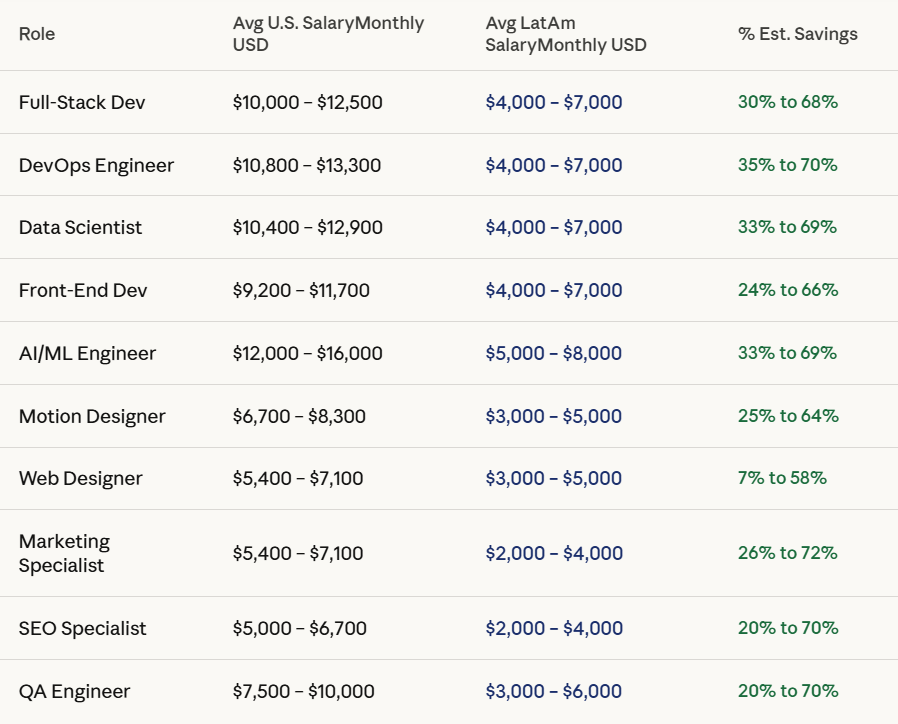
For context, a software engineer in the US costs $120,000–$180,000 per year in base salary alone, before benefits, payroll taxes, recruiting fees, and equity.
Latin American developers with equivalent skills generally cost 40–70% less, without trade-offs in quality or communication, particularly when they're operating in US time zones.
Most TaaS providers charge no upfront sourcing fees. You pay once a hire is made, and the engagement begins.
How long does it take to hire through a TaaS company?
A well-run TaaS provider can move quickly. Typical timelines:
- First candidate profiles presented: 2–5 business days
- Interview and selection: 3–7 business days (depends on client availability)
- Onboarding and first day: within 10–15 business days from kickoff
This is significantly faster than a standard recruiting cycle, which averages 6–12 weeks.
The caveat: timelines depend on how clearly you define the role upfront and how quickly your team moves through the interview process.
When does the TaaS model make sense — and when doesn't it?
TaaS works well when:
- You need to add talent quickly without a long recruiting cycle
- You want to scale headcount up or down over the next 6–18 months
- You're willing to manage remote talent directly
- Cost efficiency matters without sacrificing quality
- You want talent aligned to US time zones
It's a harder fit when your team isn't set up to onboard and manage remote talent.
The model is not a shortcut around management. Companies that treat TaaS as a way to get output without investing in remote team culture usually don't get great results.
What should you look for in a TaaS company?
Not all providers operate the same way. A few things worth evaluating:
- Vetting depth: How is talent assessed? Look for providers who conduct live interviews (not just resume reviews) and evaluate communication skills and remote readiness, not only technical abilities.
- Geographic specialization: A provider focused on a specific region will have deeper networks and better quality control than a generalist platform.
- Time zone alignment: For US companies, proximity to EST/PST hours matters. Real-time collaboration is harder to fake with async workarounds.
- Retention data: High turnover in placed talent is a signal that the provider is overpromising or underserving their people.
- HR coverage: Confirm they handle payroll, benefits, and local compliance, not just placement.
Companies like GoFasti specialize in connecting US companies with vetted talent across Latin America, handling end-to-end HR while keeping the talent fully integrated into the client's team.
Is TaaS right for your company?
If you're a US-based founder, CTO, or engineering manager evaluating how to grow your technical team, TaaS is worth understanding as a concrete option, not just a concept.
The practical appeal is straightforward: access to skilled remote talent, faster than traditional hiring, at a predictable monthly cost, without building out an international HR infrastructure yourself.
The model works best when you treat the talent as part of your team because, operationally, they are.
.svg)
.svg)
.svg)
.svg)
Hire to Win
Hiring with GoFasti means being expertly matched with world-class talent from LatAm.
hire latam talent