

Nearshoring talent acquisition: how to build better teams
Nearshoring talent acquisition: how to build better teams
Nearshoring talent acquisition means hiring skilled professionals from nearby countries (typically within the same or adjacent time zones), rather than recruiting locally or outsourcing to distant regions like Southeast Asia.
For US companies, this almost always means Latin America.
You get access to top-tier talent, saving costs, and without losing the real-time collaboration that makes remote teams function well.
A developer in Colombia, a designer in Brazil, or a project manager in Mexico can work your hours, attend your standups, and integrate into your team the same way a local hire would.
What is nearshoring in HR?
In an HR context, nearshoring refers to building part of your workforce in a geographically close country, typically to access talent that's either scarce or expensive in your home market.
It's not a staffing agency arrangement or a project-based contract, it's a long-term hiring model where the professionals you bring on are genuinely part of your team.
The distinction matters because it changes how you structure the relationship. Nearshore hires work defined hours, attend team meetings, report to your managers, and own their work.
The main difference from a domestic hire is where they're based and how their employment is managed.
What is the difference between nearshoring and outsourcing?
Outsourcing typically means handing a function or project to an external vendor who delivers results independently. You define the output, they figure out how to produce it.
Nearshoring is about adding people to your team who happen to be in another country.
With outsourcing, you have limited visibility into who's doing the work or how. With nearshore talent acquisition, you're hiring specific individuals, evaluating their skills, and integrating them into your existing workflows.
The accountability structure, communication norms, and day-to-day involvement are much closer to traditional employment.
What is nearshore vs. onshore?
Onshore means hiring within your own country. Nearshore means hiring in a neighboring country or region.
The relevant difference for most US companies isn't geography itself, it's the combination of time zone overlap, cultural familiarity, and cost structure.
Offshore talent (Asia, Eastern Europe) can be excellent, but the time gap creates real friction: delayed responses, minimal overlap in working hours, and meetings that require someone to be up very early or very late.
Nearshore talent in Latin America largely eliminates that issue. Most LatAm countries operate on time zones ranging from EST to PST, which means genuine real-time collaboration.

What roles are typically hired through nearshore talent acquisition?
Most US companies that nearshore talent fall into two broad categories of hiring:
Technical roles
Software developers (full-stack, front-end, back-end), DevOps engineers, data scientists, AI/ML engineers, QA specialists, cloud architects, and cybersecurity professionals.
Latin America has a rapidly growing pool of strong technical talent, particularly in Brazil, Mexico, Colombia, and Argentina.
A senior software developer in the US commands anywhere from $120,000 to $150,000 per year in total compensation.
A senior in Latin America typically earns between $48,000 and $84,000, depending on the country and tech stack.
Creative and operational roles
Graphic designers, motion designers, marketing specialists, SEO strategists, executive assistants, and project managers.
These roles benefit just as much from time zone alignment and often have a shorter onboarding curve.
How does the nearshore talent acquisition process work?
The process varies depending on whether you're hiring independently or working with a specialized partner, but the core steps are consistent:
- Define the role clearly: seniority level, tech stack or skill requirements, working hours, and what success looks like in the first 90 days.
- Source candidates: either through LatAm-specific job platforms, referrals, or a hiring partner with an existing network.
- Screen for English proficiency and remote readiness: not just technical skills. Many candidates have strong portfolios but limited experience with async communication tools or remote team norms.
- Conduct technical and cultural fit interviews: same rigor as a local hire, adjusted for the remote context.
- Handle compliance: this is where many companies hit friction. Employment law in Brazil, Mexico, Colombia, and other LatAm countries varies significantly. If you're not familiar with local labor regulations, misclassifying workers as contractors when they should be employees creates real legal exposure.
- Onboard and integrate: documentation, tooling access, introductions, and a clear 30/60/90 plan. The first three months are disproportionately important for retention.
Companies like GoFasti handle sourcing, vetting, compliance, payroll, and HR management for US companies hiring in Latin America, which reduces the timeline and legal complexity significantly.
You get profiles to review within 48 hours and can hire someone in 10 days instead of months.
What does nearshore talent acquisition actually cost?
The cost depends on the role, country, and seniority level, but here's a range for common positions.
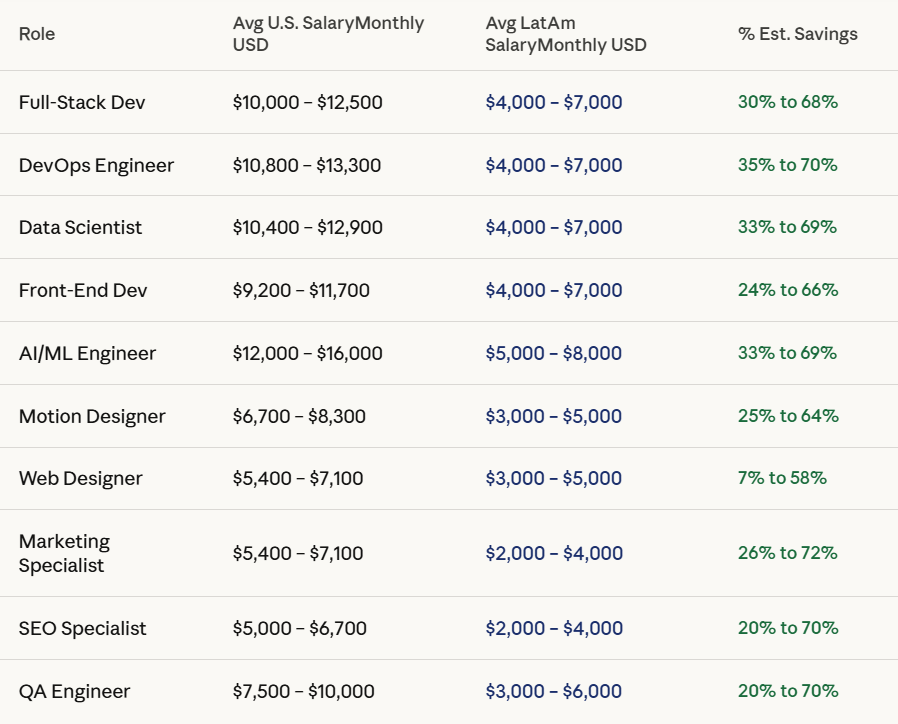
You can save up to 70% on hiring, and the savings aren’t even the best part.
GoFasti talent, for example, has a 97% talent retention rate because the talent is great at what they do and grateful for the opportunity to work in a global team.
What are the most common mistakes companies make?
Hiring for cost alone
The savings are real, but treating nearshore talent as a way to get "cheap developers" creates the wrong dynamic.
The professionals who consistently perform well are motivated by interesting work, growth opportunities, and being treated as full team members, same as anyone.
Underinvesting in onboarding
Remote hires, wherever they're based, need structured onboarding. Without it, the first 30 days feel uncertain, and that uncertainty compounds.
Skipping legal compliance
Hiring someone in Brazil as an independent contractor when they're working 40 hours a week exclusively for your company creates legal risk under Brazilian labor law. The rules are different in every country.
If you don't have in-country expertise, use a partner who does.
Expecting instant cultural alignment
LatAm professionals integrate well with US teams, but "no cultural barriers" doesn't mean zero adjustment period. Communication styles, feedback norms, and meeting etiquette vary.
A short onboarding investment in these areas pays off quickly.
When does nearshoring make the most sense?
Nearshore talent acquisition is a strong fit when:
- You're scaling a technical or creative team, and local candidates are either too expensive or too hard to find.
- You need real-time collaboration and can't afford a significant time zone gap.
- You're building long-term roles, not project-based work.
- Your team has experience managing remote employees or is willing to develop that capability.
It's less ideal if your role requires a physical presence, involves highly regulated work with in-country licensing requirements, or if your internal processes aren't yet built for distributed teams.
Nearshoring talent acquisition: the bottom line
For US founders, CTOs, and hiring managers, the core question isn't whether nearshoring works. The evidence that it does is well-established.
The question is whether your organization is set up to make it work well.
That means defining roles clearly before you source, investing in onboarding, managing compliance properly, and treating nearshore hires as core team members.
When those conditions are met, nearshore talent acquisition in Latin America offers a combination of cost efficiency, time zone alignment, and talent quality that's genuinely hard to replicate through domestic hiring.
.svg)
.svg)
.svg)
.svg)
Hire to Win
Hiring with GoFasti means being expertly matched with world-class talent from LatAm.
hire latam talent